
Common misconception: a browser wallet that looks like MetaMask is just “another” hot wallet. That assumption misses a structural difference that matters for heavy DeFi users — specifically, whether the wallet forces you to sign transactions blind or gives you a crystal-clear preview of what will change. Rabby’s design centers on that preview: transaction simulation, risk scanning, and multi-sig integrations shift the operational trade-offs for users who run complex flows across many chains.
This piece examines how Rabby’s browser extension and desktop/mobile clients change the practical security model for US-based DeFi power users. I’ll show the mechanisms—how simulation and pre-signing analysis work—compare them to typical alternatives, identify remaining blind spots, and offer concrete heuristics for when Rabby’s feature set meaningfully reduces risk versus when extra controls (hardware keys, a multisig vault) are still necessary.
How Rabby’s transaction simulation and risk engine work (mechanism first)
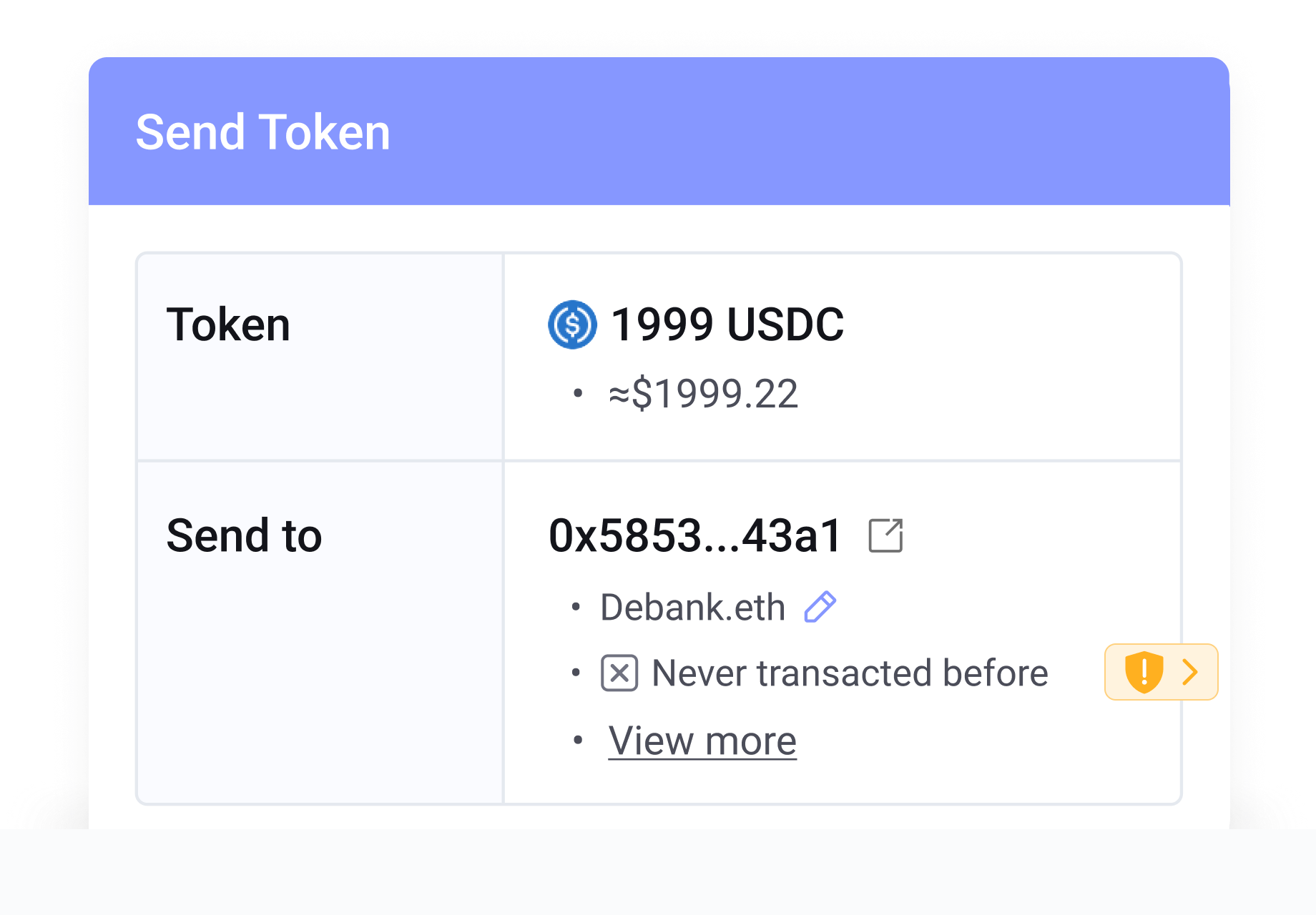
At the heart of Rabby’s differential advantage is simulation. Before you sign, the wallet executes a local, off-chain run of the intended transaction against a node or a forked state to compute expected token balance deltas, gas costs, and intermediary contract calls. In plain terms: instead of trusting an opaque hex blob and a gas estimate, you see a concrete statement — “you will send 10 USDC, receive 0.5 WETH, and pay X in gas” — derived from running the exact call. That prevents a class of attacks commonly called blind signing, where a malicious dApp tricks a user into authorizing an action that differs from the user’s mental model.
Rabby layers simulation with a pre-transaction risk scanner. The scanner flags things like interactions with contracts that have been previously exploited, approval requests that would grant unlimited token allowances, and transfers to non-existent or high-risk addresses. Both features are local-first: simulation happens before the transaction is transmitted; the risk engine queries known data to attach warnings. Mechanistically, this is a diagnostic pipeline: parse transaction -> simulate -> annotate with heuristic signals -> present human-readable output.
Why that mechanism matters in practice (trade-offs and decision-useful framing)
For a DeFi power user, the relevant decision problem is not “is this wallet secure?” but “how much uncertainty remains in this particular flow?” Rabby reduces epistemic uncertainty about the immediate outcome of a transaction. Instead of a binary trust decision based on a vendor or UX, you get a probabilistic, evidence-backed preview. That matters when you execute composable DeFi flows (e.g., swap -> provide liquidity -> stake) where a single mistaken approval can cascade into large losses.
There are trade-offs. Simulation and scanning can generate false positives and false negatives. A flagged contract may be a benign new project that simply lacks history; conversely, a previously unaudited contract could be zero-day malicious and not yet appear on warning lists. Simulation depends on node state and on-chain data; highly time-sensitive trades on congested chains may have different on-chain outcomes than the simulation predicted because front-running or MEV changed state between simulation and the actual inclusion in a block. So simulation reduces a very specific kind of risk — unintended effects from blind signing — but it does not eliminate replay, front-running, or all kinds of social-engineering attacks.
Where Rabby fits in the multi-chain toolbox: features that alter workflows
Rabby is explicitly multi-chain, supporting over 90 EVM-compatible networks and automatic network switching when you visit a dApp. That reduces friction and human error during cross-chain workflows, a common source of failed transactions for traders and arbitrageurs. Portfolio aggregation and asset tracking present a synthesized view across tokens, NFTs, and DeFi positions, which is valuable for monitoring exposure without hopping between explorers or multiple wallet UIs.
Operational advantages for institutional or higher-risk users include native integrations with multi-signature and custody solutions (Gnosis Safe, Fireblocks, Amber, Cobo) and broad hardware wallet support (Ledger, Trezor, Keystone, etc.). These integrations mean Rabby can act as a transactional interface while custody and approval authorities remain in a separate, hardened plane — a practical separation of signing surface and custody that mitigates single-point-of-failure concerns.
Where Rabby does not solve everything (limits and boundary conditions)
Two clear limitations matter in practice. First, Rabby has no built-in fiat on-ramp. For US users who prefer a single in-wallet fiat purchase, Rabby forces out-of-wallet steps or third-party integrations to bring in token liquidity. Second, there is no native in-wallet staking feature. If you routinely stake tokens as part of your yield stack, you will need supplementary tooling or custodial services to manage validator interactions.
Past incidents also warrant sober attention. In 2022 a smart contract linked to Rabby Swap was exploited for roughly $190,000. The team’s response — freezing the contract, compensating users, and increasing audits — is relevant evidence that the project took remediation steps. But the incident is also a reminder that wallet ecosystems are not immune to linked-contract risk: a wallet vendor can harden its UI and signing pipeline, but dApp contracts it integrates with remain external attack surfaces.
Non-obvious insights and a practical heuristic for power users
Insight 1: Transaction simulation reduces information asymmetry, not authorization risk. It tells you what will happen now; it does not change what approvals you granted earlier. That’s why Rabby’s approval revocation tool is more than convenience — it is complementary. Use simulation to verify actions and the revocation tool to reduce future exposure.
Insight 2: Automatic network switching reduces cognitive load but raises a subtle UX security trade-off. The wallet will switch networks for you; that’s convenient for multi-chain dApps but means you must be attentive to which account and which hardware signer are active on the new network. The heuristic: when moving significant value, enable a hardware wallet or require multisig confirmations on the receiving chain before you transact.
Decision-useful heuristic: For routine, low-value interactions (small swaps, NFT browsing), Rabby’s simulation + revocation workflow materially reduces common user mistakes. For high-value, composable flows (> five-figure USD exposure) you should combine Rabby’s interface with a hardware signer and, where feasible, a multisig or institutional custody layer. That stacking preserves Rabby’s UX benefits while limiting single-device or single-key risks.
Comparisons and when to prefer alternatives
Compared to MetaMask, Trust Wallet, or Coinbase Wallet, Rabby is not trying to win solely on brand or fiat rails. It differentiates via simulation, automatic network switching, and deeper integrations for enterprise custody. If your priority is an in-wallet fiat purchase and a simple consumer UX, other wallets remain competitive. If your workflow involves cross-chain arbitrage, many dApps, and you value step-by-step confirmations of effects, Rabby’s model reduces a specific operational risk that alternatives leave exposed.
One more boundary: simulation increases computational load and UX complexity. If you work on a low-performance machine or use older browser versions, the extension may feel heavier than a minimal wallet. That’s a trade-off between richer pre-execution diagnostics and responsiveness.
What to watch next (signals and near-term implications)
Monitor three signals that will determine whether Rabby’s model scales for broader DeFi power users in the US market: 1) whether open-source audits keep pace with expanding multi-chain support; 2) improvements to front-running and MEV-resistant primitives that could make simulation more predictive; and 3) ecosystem partnerships that bring fiat rails into the workflow without sacrificing the non-custodial model. If Rabby combines its simulation pipeline with stronger market-data integrations and optional custodial on-ramps, it could become the default interface for advanced retail traders who need both assurance and convenience. Conversely, if false positives in the risk engine grow with chain coverage, user trust may erode.
For a practical next step: if you want to test the workflow, try importing a test wallet, connect a hardware signer, and run a harmless token swap on a small scale. Use the approval revocation tool afterwards to see how easily approvals can be constrained. If you want to install the browser extension, consider the official distribution and read the open-source repo or audits first; for convenience, explore the rabby wallet extension page to confirm supported platforms and download channels.
FAQ
Does Rabby prevent all smart-contract hacks?
No. Rabby’s simulation and risk scanning reduce the chance you sign an unintended transaction, but they cannot make external smart contracts safe. Simulations can miss zero-day vulnerabilities, and once you grant a token approval, other on-chain mechanisms (or compromised contracts) could still drain funds unless approvals are revoked or custody is separated.
Is Rabby a custodial wallet?
No. Rabby is non-custodial: private keys remain under user control unless you choose to integrate with a third-party custody service. That means security is partly user-managed — hardware wallets and multisig setups remain recommended for large holdings.
Can Rabby replace a hardware wallet or multisig for institutions?
Not on its own. Rabby integrates with institutional custody tools and multisig setups and is best used as an interface layer coupled with those hardened key management solutions. For institutions, the secure pattern is separation: Rabby for UX and transaction construction; a custody provider or multisig for signing policy enforcement.